

Long before there were band shell concerts, candlelit Fourth of July nights, or ducks drifting down the stream, there was a spring. Cold, clear water bubbled out of a limestone ledge in what is now the heart of Lititz, Pennsylvania, and it drew people to this spot for centuries.
The story of Lititz Springs Park history is really the story of Lititz itself: Native Americans, Moravian settlers, Revolutionary War soldiers, railroad day-trippers, and generations of families who have kept this seven-acre park alive with volunteer work and community pride. Here’s how it all unfolded.
Lititz Springs Park History Timeline at a Glance
| Year | Milestone |
| Centuries ago | Native Americans, including the Nanticokes, live near the springs |
| 1722 | Christian Bomberger becomes the first known European settler in the area |
| 1729 | Richard Carter settles nearby; the creek becomes known as Carter’s Run |
| 1742 | Count Zinzendorf preaches near Lititz while seeking land for a Moravian community |
| 1756 | Zinzendorf names the settlement “Litiz” |
| 1778 | First recorded use of the springs as a pleasure ground: evening concerts |
| 1780 | A rough stone wall is built around the spring basin |
| 1792 | Town permits an acre around the “Big Spring” for recreation; arched stone bridge built |
| 1818 | First Lititz Fourth of July celebration |
| 1856 | Elliptical sandstone springhead completed; the springs dedicated as a public park |
| 1857 | The famous carved lion’s head is added near the springhead |
| 1863 | Railroad arrives, bringing picnickers from Reading and beyond |
| 1884 | Railroad station built on the park grounds |
| 1927 | Boy Scouts build the Log Cabin on the hill |
| 1937–1940 | Park Improvement Project builds the band shell, dedicated to Paul E. Beck |
| 1956 | Elmer H. Bobst gives $100,000 to restore the park; management passes to a community Board of Trustees |
| 1958 | Park rededicated to the community |
| 1986 | Lititz Moravian Historic District listed on the National Register of Historic Places |
| 1993 | New community-built playground dedicated on July 4 |
| 1994 | Memorial fountain dedicated; first “Christmas in the Park” |
| 2026 | The 209th Fourth of July celebration is held in the park |
Before Lititz: Native Americans and the First Settlers
Native Americans such as the Nanticoke occupied the land before it became Lititz Springs Park for many years. Remnants of Native Americans have been found at the headwaters of the springs. In those days, the headwaters of the springs were wetlands supported by a number of underground water sources coming from hills to the northwest of the city. This site was used as a natural watering place for the cattle.
White settlers appeared in the late 1700s. Christian Bomberger is regarded as the first European settler of the place in 1722. Richard Carter, who arrived in Lancaster County from Warwickshire, England, in 1729, lent his name to the creek of the park, previously referred to as Carter’s Run and now known as Lititz Run.
One of the earliest stories associated with the springs involves an elderly man Daddy Huhn, who used to reside in Owl Hill. He remembered going to the spring in 1730 as a little boy to get his father’s horse which he purchased from the native Americans occupying the territory.
The Moravian Founding and the Lititz Moravian Historic District
Lititz came about as a result of a religious vision. Count Nicholas Ludwig von Zinzendorf of Saxony, who was the leader of the modern day Moravian Church, preached in a tavern north of Lititz in 1742 when he was searching for land on which to found a Moravian settlement. A local farmer by the name of John George Klein later offered the church a plot of land totaling 491 acres running along Carter’s Run.
In 1756, Zinzendorf wrote to the settlers naming the settlement “Litiz,” which is a Germanized form of the name of the Bohemian castle of Litice, where the early Moravian Brethren took shelter in 1456. Later on, the name would be written as “Lititz.” The town remained a closed Moravian settlement during its first hundred years.
Much of that early town still stands. The Lititz Moravian Historic District was listed on the National Register of Historic Places in 1986. It includes:
- The Lititz Moravian Church (1787)
- The Sisters’ House (1758) and Brothers’ House (1759)
- The Corpse House (1786)
- The Mary Dixon Memorial Chapel (1884) on the campus of Linden Hall
- The General Sutter Inn, originally the Zum Anker tavern (1764), now Lititz Springs Inn & Spa
The springs sat at the edge of this Moravian world, and their history is closely tied to the church that owned them for more than 200 years.
1778: Revolutionary War Soldiers and the First Concerts
During the American Revolution, General Washington ordered wounded and sick soldiers to Lititz, where the Moravian Brothers’ House served as a hospital. In May 1778, music teacher Tobias Hirte and a small orchestra of the town’s young men began giving evening concerts at the springs. It’s the first recorded use of the site as a place for enjoyment.
The Moravian governing board, the Aufseher Collegium, saw the concerts as too worldly. But the soldiers recovering from the battles of Brandywine and Germantown loved them. It was a sign of what the springs would become: a place where the community gathered to relax.
Shaping the Park: 1780–1856
Slowly, the marshy spring became a park:
- 1780: A rough stone wall went up around the basin. The swamp to the north was deep enough in spring that people could row boats on it.
- 1792: Citizens met to improve the springs. The town leaders worried a pleasure ground would encourage worldliness, but they gave permission to use an acre around the “Big Spring.” Trees were planted, arbors and walks were built, and the arched stone bridge was constructed.
- 1810: The town’s young men planted an avenue of locust trees leading from the springhead toward the Manheim road.
- 1835–1840: Volunteers built fences for thirty dollars and added improvements year after year.
- 1846–1856: John Beck, principal of the Lititz Academy, cared for the grounds and paid for tree planting from his own pocket. When the bank around the springhead was reshaped in 1855, three more springs were uncovered. They still flow from the wall today.
- 1856: Using sandstone from the Colemans of Brickerville, townsmen built the graceful elliptical springhead. That year the springs were dedicated as a public park.
The Legends of Lititz Springs Park
Every old park has its stories, and the legends of Lititz are tied to the people who shaped this place. These are the details visitors walk past every day, often without knowing the stories behind them.
The Lion’s Head
The carving of a beautifully made lion head was created by J. Augustus Beck in 1857. This sculpture by Beck was placed on the right side of the spring, next to the stairs. He was an artist and a sculptor, and this lion has been watching the springs since 1857.
“God’s Fount Is Never Failing”
Later on, Paul E. Beck, together with his father, Abraham and his brother Herbert, placed a stone tablet with a German inscription which means “Gottes Brünnlein hat Wasser die Fülle,” or “God’s fount is never failing.” It was an appropriate message for a city based on faith, and the spring has continued to flow until today.
The Candles of the First Illumination
The candlelit Fourth of July is one of the great legends of Lititz. Local tradition remembers Lizette Hamm Weitzel as the woman who made the candles for the first July 4th illumination. Today, more than 4,500 candles are lit through the park every Independence Day, continuing a tradition that started in 1818.
The Round House Mystery
The Round House is the oldest building on the grounds. It was rebuilt in the park in 1880, and historians believe it was probably moved from a fairground near Lititz. No one knows its full story for sure.
A Secretary of State in the Park
On July 25, 1914, William Jennings Bryan, then Secretary of State under President Woodrow Wilson, spoke in the park during the Chautauqua meetings. It’s one of the most famous visits in park history.
The Railroad Era: Picnics and Crowds (1863–1900s)
None of the individuals that initially developed the springs could have anticipated how popular a picnic spot it would eventually become. This occurred in 1863 with the construction of the railroad. People started arriving by train from Reading and other surrounding communities, with picnic groups becoming a frequent occurrence.
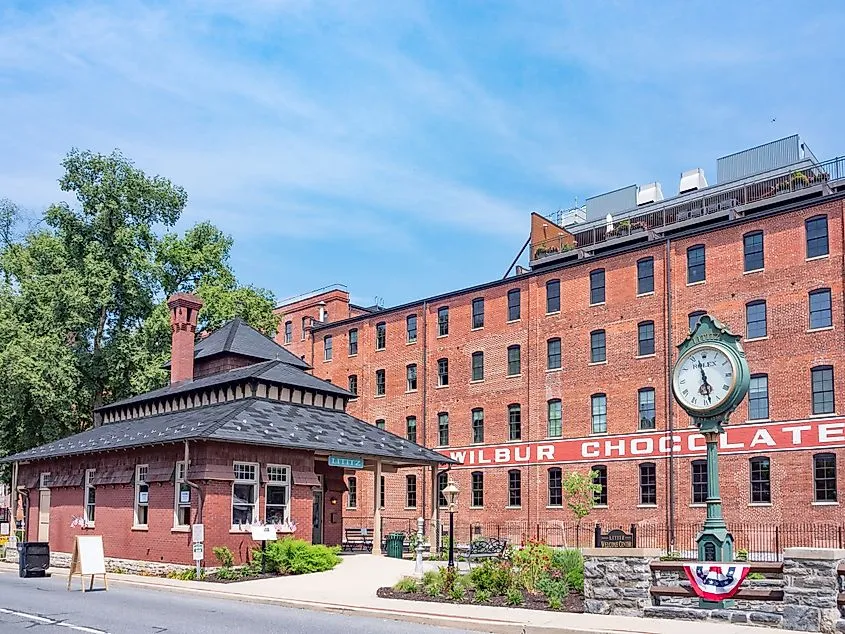
The Moravian congregation, in 1884, leased the northeast corner of the property to the Philadelphia and Reading Company for the establishment of a passenger and express station. As a result of the railroad station being located right in the park, the annual Fourth of July celebration kept growing bigger and bigger. Today, the train station serves as the Lititz Welcome Center.
The Golden Age of Park Events (1906–1940)
- 1906: An octagon-shaped music pavilion, designed by Paul E. Beck of the Beck Concert Band, was built.
- 1908: Belshazzar’s Feast, a huge musical show directed by local teacher Calvin S. Loeffler, ran for three days in August.
- 1912–1914: Week-long Chautauqua meetings brought lectures, plays, and concerts to the park.
- 1920: The last encampment of Stevens Post No. 517 of the Grand Army of the Republic was held on Decoration Day.
- 1927: Lititz Boy Scout Troops 2 and 3 built the Log Cabin on the hill behind the springhead.
- 1937: P.F. Snyder asked the Lititz Chamber of Commerce to help improve the park. This led to the band shell, dedicated to Paul E. Beck.
- 1940: The new Lititz Dramatic Theatre staged George Washington Slept Here in the band shell.
1956: A Gift That Saved the Park
By the mid 1950s, time and weather had left the park dilapidated. During the summer of 1956, when Lititz marked its bicentennial year, Elmer H. Bobst visited his childhood town as part of the bicentennial celebrations. Elmer was a renowned philanthropist and chairman of the Warner-Lambert Pharmaceutical Company, and much to everyone’s surprise he announced that he was donating $100,000 towards the restoration of the park.
In the same month of October, Lititz Moravian Congregation continued owning the park while transferring management to a Board of Trustees consisting of 12 members from local churches and community via a Declaration of Trust which also stipulated that the Fourth of July celebrations continue. On September 14, 1958, the park was officially rededicated to the community after being restored.
Modern Milestones (1976–Today)
- 1976: A 250-voice community chorus sang in the park on July 4 for the nation’s Bicentennial.
- 1979–1980: Fred Waring and his Young Pennsylvanians performed in the park.
- 1981: The park hosted a celebration marking Pennsylvania’s 300th anniversary and Lititz’s 225th, with an address by Governor Richard Thornburgh.
- 1993: A community-funded playground with an accessible children’s area, fitness course, and volleyball court was dedicated on July 4.
- 1994: The VFW memorial fountain was dedicated at the main entrance. The park board also took on care of Lititz Memorial Square, including the annual Christmas Nativity scene.
- December 2, 1994: The first Christmas in the Park was held, with a community tree lighting and 1,000 candles on the stream.
How the Park Survives Today
Lititz Springs Park is a private, nonprofit park that receives no tax money. It’s still owned by the Lititz Moravian Congregation, and it stays open thanks to volunteers, pavilion rentals, donations, and its biggest fundraiser: the Lititz Fourth of July celebration. You can support the park through the official donation page.
The Lititz Historical Foundation: Where to Learn More
If the park’s history leaves you wanting more, visit the Lititz Historical Foundation, just a short walk away at 137–145 E. Main Street. Founded in 1961 by local residents, the foundation operates:
- The Lititz Museum in the 1793 Christian Schropp home, with an illustrated timeline of Lititz from Native American settlements to today and a room dedicated to General John Sutter, who lived in Lititz from 1871 to 1880.
- The Johannes Mueller House (1792), where costumed guides show what life was like for a Moravian tradesman and his family.
- The Mary Oehme Gardens, a popular spot for summer concerts and weddings.
- Walking tours of historic Main Street, plus ghost tours and whiskey-and-history tours.
Visit the Lititz Historical Foundation to book a tour, or call 717-627-4636.
Self-Guided History Walk Through the Park
- Start at the Welcome Center in the 1884-era train station at the park entrance.
- Stop at the memorial fountain (1994) at the main entrance.
- Walk along the stream, which follows the old Carter’s Run.
- Visit the springhead (1856), find the lion’s head (1857) and the German tablet, and look for the three springs uncovered in 1855.
- Climb to the Log Cabin (1927) on the hill.
- Find the Round House (rebuilt 1880), the oldest building on the grounds.
- End at the band shell, dedicated to Paul E. Beck.
- Continue to Main Street to explore the Moravian Historic District and the Lititz Historical Foundation.
FAQ: Lititz Springs Park History
How old is Lititz Springs Park?
People gathered at the springs for centuries, and the first recorded recreational use dates to 1778. The springs were formally dedicated as a public park in 1856.
Who owns Lititz Springs Park?
The Lititz Moravian Congregation still owns the park. Since 1956, it has been managed by a 12-member community Board of Trustees through a Declaration of Trust.
What is the Lititz Moravian Historic District?
A historic district in downtown Lititz listed on the National Register of Historic Places in 1986. It includes the 1787 Moravian Church, the Sisters’ and Brothers’ Houses, and the original Zum Anker tavern.
What are the best-known legends of Lititz Springs Park?
The lion’s head carved in 1857, the “God’s fount is never failing” tablet, the candles made for the first July 4th illumination, the mysterious Round House, and William Jennings Bryan’s 1914 speech.
What does the Lititz Historical Foundation offer?
The Lititz Museum, guided tours of the 1792 Johannes Mueller House, the Mary Oehme Gardens, and walking, ghost, and history tours of Main Street.
How did Lititz get its name?
Count Zinzendorf named it in 1756 after the castle of Litice in Bohemia, where early Moravian Brethren found refuge in 1456.
Final Thoughts
Lititz Springs Park history spans more than 280 years of Moravian faith, Revolutionary War music, railroad picnics, and community volunteers. The spring the settlers found is still flowing. Next time you walk past the lion’s head or watch candles glow along the stream, you’ll know the story behind them.
Do you need more information about Visiting Lititz Springs Park

One thought on “Lititz Springs Park History: From Moravian Spring to Community Treasure”